Alan Merrett - English version
ENTREVISTAS
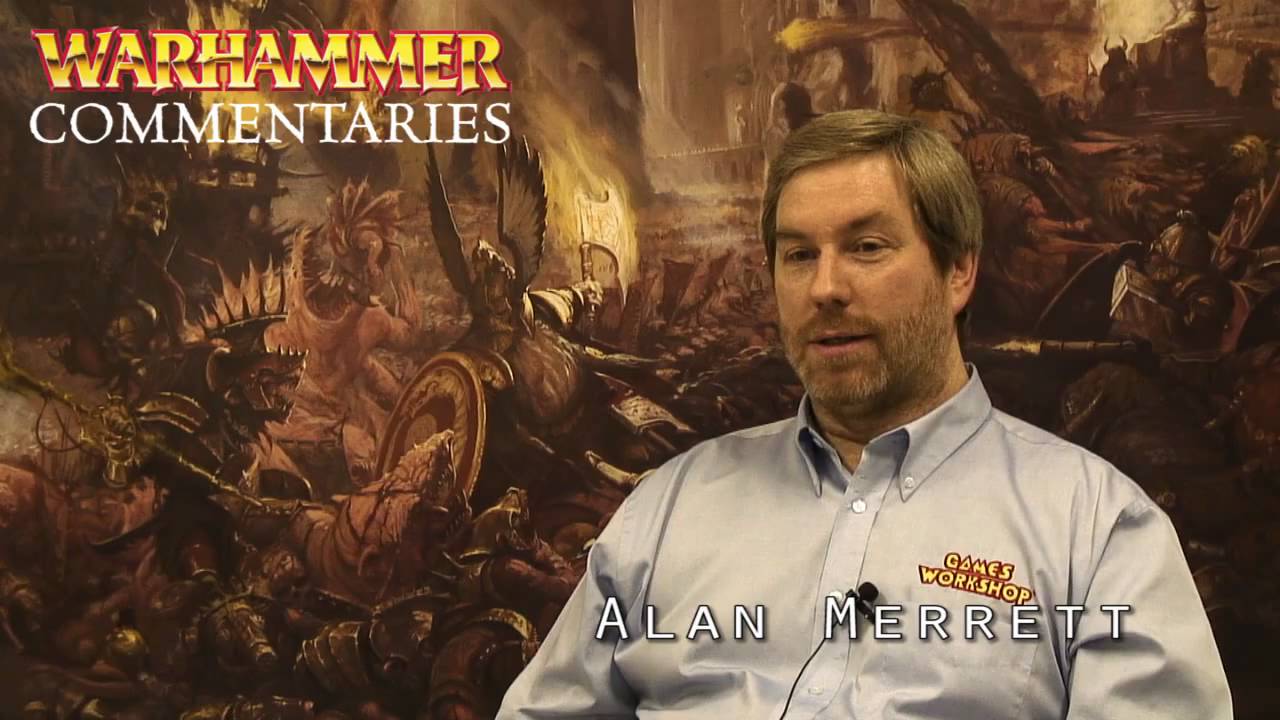
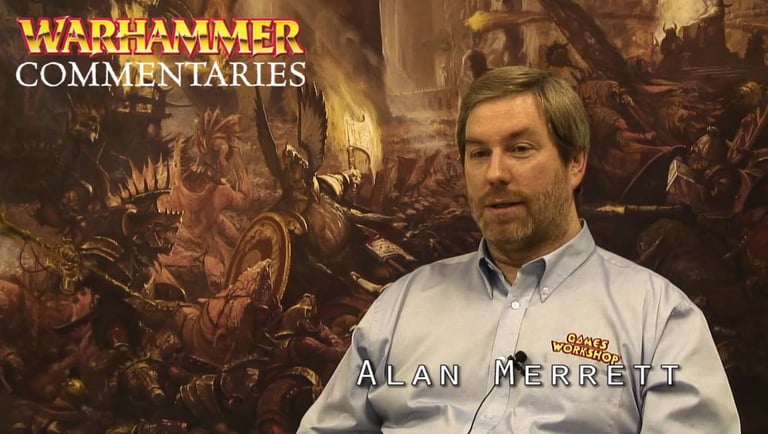
Alan Merrett on HeroQuest, Advanced Heroquest, and the Games Workshop-Milton Bradley Alliance.
Today, we have the distinct pleasure of speaking with Alan Merrett, a pivotal figure at Games Workshop during that era. Join us as he shares the inside story of how this legendary game and its sibling, Advanced Heroquest, came to be.
Complete interview with Alan Merrett
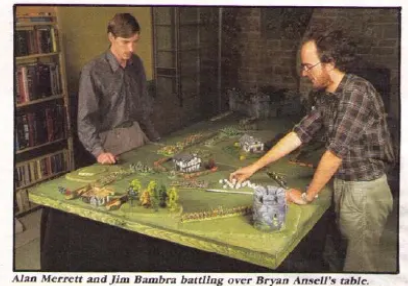
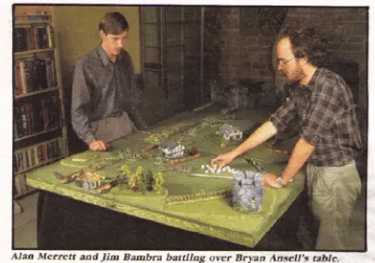
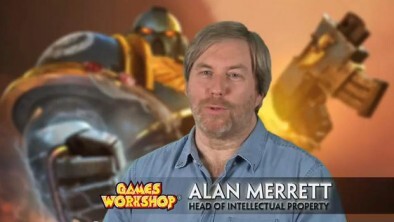
Thanks Alan for agreeing to this interview, could you tell us a bit more about your professional background? How did you start working at Games Workshop (GW) in 1980?
Alan Merrett: Hello, nice to be here. Thanks for inviting me to talk about this little bit of GW history. I joined the fledgling Citadel Miniatures in April 1980. Citadel at the time was co-owned by Steve Jackson and Ian Livingstone, of Games Workshop fame, and the legend who was Bryan Ansell. My first job was as a caster - it wasn’t a job I thought I’d be doing for very long. My ambition at the time was to reapply to a university and resume my degree studies having been kicked out of Nottingham Uni after a single unsuccessful year! The casting job was to tie me over until the summer. In the end I spent the best part of four decades working for Citadel/Games Workshop! Never did get that degree! Bryan simply kept giving me more things to do and responsibilities to dispose of. From casting I moved onto mould making, then later onto master mould making which led to liaising with the miniature’s designers. In between times I worked on mail orders, trade orders and a range of general management duties! Bryan thought I was a pretty decent mould maker and not that good dealing with folk on the telephone. That pretty much defined my future progress as I became more and more involved with the miniatures and product design side of things. When the Design Studio was set-up, it was inevitable that I would end up working there and as the master mould maker I sort of took the miniatures designers with me!
Prior to your time at Games Workshop, did you play any board games? If so, what were some of your favorites?
AM: I wouldn’t say I was a board game enthusiast but I certainly played a great many different games. I was an avid miniatures wargamer form an early age and there was a great deal of cross-over between wargaming and board games. Always loved Risk but favourite game had to be a game called Warlord which became Apocalypse when GW published it. And although not a board game I loved D&D - both playing and DMing.
Regarding the collaboration between Games Workshop and Milton Bradley for HeroQuest, how did you first learn of the partnership? For our readers interested in the history of this classic game, were you involved in the negotiations, and can you recall who from both GW and MB spearheaded the deal and the timeframe for these discussions?
AM: I honestly can’t remember how it all started. Bryan was heavily involved of course (nothing happened at Citadel/GW in those days without him being heavily involved). I remember when Bryan told me that I would have to get all the miniatures designers working on the models for the game and that this would take priority over everything else - and that I had to make sure that GW had something to release in the meantime! Typical Bryan! I’m pretty sure we had plenty of discussions before that point - I can’t remember talking about the game at all, only what models we would want to make for it. I think the principle that we would make the models and MB would design the game (and source all the artwork for it) was established very early on. Bryan would certainly have had strong ideas about the later but I’ve no idea how much traction he got for MB for any of his input. Bryan was more interested in what we could do in the wake of the game’s release - hence Advanced Heroquest.
Delving into that collaboration, what was the dynamic like between the Games Workshop and Milton Bradley creative teams? For instance, how closely did you work with their personnel, such as Stephen Baker, to navigate the development process?
AM: Steve had worked for GW in London before we moved the whole thing up to Nottingham. He was a keen boardgame designer and I recall going to BBC Enterprises with him on one occasion to pitch two games to them. One was a game that he had been working on (for some reason my memory tells me it was based on the Labyrinth film - but this might be my memory playing tricks on me). The game I was pitching was a Dr Who game designed by the late, great Richard Halliwell (Hal). Hal’s game was called the Five Doctors and was a romp through time and space featuring virtually every character and villain from the show. The BBC Ents chap was jolly nice, treating Steve and I to a spectacular lunch delivered on a silver trolly, but he wasn’t at all interested in our pitches. ‘Too much work having to pursue all those approvals from the picky actors, let alone the writers, let me tell you.’ As for Heroquest we had a very hands-off attitude to the game design. I can’t recall any kind of meeting between the parties that discussed the game or its mechanics. All the meetings I was involved in were about delivery deadlines, progress on miniatures design work and the intricacies of the tooling formats. Plastic tooling for us was massively expensive and we worked hard to extract every last penny out of money we spent on the tools for plastics. MB’s people were far more concerned about the cost of the frames not the tools. They thought nothing of spending double or triple what we would have thought necessary on the tools if the frames moulded from them could be a couple of pennies cheaper! This was a constant thorn in my side because they kept asking for more design work - eg extra heads and/or weapons - which I had to try and get the miniatures designers to do!
Regarding the development of MB's HeroQuest, it's understood that many initial concepts, such as a modular board and character progression, were simplified as they were deemed too complex for youngsters. For our readers in the fan community, it has long been believed that these discarded ideas were later revived for Games Workshop's Advanced HeroQuest.
Could you please confirm if this was indeed the case, and whether this reuse of ideas was part of the agreement between GW and MB? Related to this, could you recall the extent to which the design teams from both companies worked together, and for how long, to develop the final version of HeroQuest?
AM: I was not aware of any such level of cooperation or discussion. The design of the Heroquest game was entirely MB’s bailiwick and Advanced Heroquest was a totally different game.
Regarding the core design of the game, apparently Bryan Ansell himself once insinuated that after the collaboration agreement was signed, Games Workshop discarded all of Milton Bradley's work on HeroQuest. The suggestion was that GW then rebuilt the game almost entirely for MB to ensure its success in the mass market. For the purpose of historical clarity, we would be grateful if you could comment on the accuracy of this information.
AM: I cannot comment because I have no idea if this happened. If it did then it was something that Bryan must have done e in completely isolation from the rest of us! He may well have reacted to an early draft of the game form MB and provided them with ‘helpful’ advice and/or input. But I have no memory or knowledge of this. Sorry.
Regarding the intellectual property in Hasbro's 2021 reissue of HeroQuest, it is widely known that terms belonging to Games Workshop, such as 'Fimir', 'Chaos', 'Karak Varn', and 'the Worlds Edge Mountains', were replaced with alternatives. For our readers interested in the history of the game, we know this was a condition set by GW for the reissue. Could you please clarify what other terms or specific intellectual properties used in the original Milton Bradley game were also protected by Games Workshop's copyright?
AM: I’m not sure that at that time we were quite so protective of these terms as you imply. The names of some things were changed from the original GW ones because MB thought them to be too niche and that a MB audience wouldn’t understand what they were. My memory is that MB asked us to revisit some names and we offered the rather bland alternatives to stop them giving them completely inappropriate names! I can’t speak for the later contract and copyright issues.
A related point of uncertainty for fans is the villain's name. In the classic UK version, he was Morcar, yet GW later had characters named 'Morkar'. This has raised a question among the fans: was the name 'Morcar' itself a GW property? If it was not, do you recall if there was a particular reason it wasn't protected by GW, whether there was simply no need, or if the name was considered entirely the property of Milton Bradley? This question is partly prompted by the fact that in both the original American release and the new Hasbro edition, the character was renamed 'Zargon'.
AM: Aaaaargh! Sorry I have no idea what happened here. Copyrights and suchlike are terribly dull subjects really. Maybe we wanted to use the name or it fell into a bag of names we felt we should own and not MB. I honestly cannot recall.
The HeroQuest miniatures are legendary. Could you describe your role in their design and approval, and how the team balanced creating a unique look for the game while ensuring it remained recognizably within the Warhammer Fantasy universe?
AM: The Citadel miniatures designers did what they did. My job was to try and ensure that they knew what they were doing, when it was to be finished and if they needed more materials! We trusted them to create the designs and if you asked say Kev Adams to design an orc you pretty much knew what you would get from him. I remember working on the list of models required for the game with Bryan and a couple of other folk. We went for a fairly standard set of heroes and a range of ‘typical’ GW (ie Warhammer) monsters to provide the denizens of the dungeon. My memory is not clear on this but we may well have had the designers make metal prototypes of the intended models before the clay masters for plastic production were made. We did this for our own games later on - because we needed models to use for the box art and suchlike and couldn’t wait for the plastic models to be available. We may have done this as part of the liasing with MB during the planning stages. Anyway, we had a very clear plan of what models we wanted. The biggest challenge was the sheer number of masters we had to sculpt and that this was the most intensive plastics project we had ever attempted. At one stage all of the designers (except maybe Kev Adams) were sequestered in the Marauder Miniatures office working on the clay masters. I would pop in regularly to track progress and deal with any issues arising. On more than one occasion I would have a sculpting tool thrust into my hand and told to smooth this bit of armour or work on this bit of fur. I must have spent the best part of a day fettling the bandages on that bloody Mummy model! The team certainly learned a lot about plastic model designing whilst working on the project.
The partnership with MB produced further hits like Space Crusade and Battle Masters but eventually came to an end. From your perspective, what were the factors that led to the conclusion of this highly successful collaboration?
AM: We needed to have our designers making Citadel miniatures for the GW business to sell. Our design resource was rare and precious to us - finding new designers in those days was very difficult. But there was also a natural divergence of objectives. I think we (ie Bryan) had much more influence on those later games than we did over Heroquest. I seem to recall that Battle Masters was very much Bryan’s baby in terms of overall structure and design ambition. But MB wanted more and different things that we did. They even commissioned new models from third parties for one or two of the later Heroquest supplements - we were not impressed! All good things come to an end.
In parallel with HeroQuest, Games Workshop released the much more complex Advanced Heroquest. What was the primary motivation behind developing this game, and was a more advanced version always part of the strategic plan?
AM: I’d like to say that there was a sophisticated strategy behind this but it was dead simple. Bryan saw Advanced Heroquest as a way to grab some of the marketing and promotional value from the Heroquest project and directly feed it into promoting purchases from GW. Also to stop GW customers simply abandoning us and going off to buy and play Heroquest! He also thought the we could make a game that was more suited to the hobby board game market than Heroquest could ever be.
What was your contribution to Advanced Heroquest? Were you also involved in its expansion Terror in the Dark?
AM: Business as usual for me and the rest of the GW designers. I can’t remember exactly what I did for It other than all my normal day to day duties working in the Design Studio. No doubt that would have involved managing designers, artists, layouts and graphic design as was normal. I probably got involved in editing and playtesting - because that was also normal.
The "dungeon crawl" genre is experiencing a major resurgence. In your opinion, why do HeroQuest and Advanced Heroquest continue to hold such a special place in the hearts of gamers decades after their release?
AM: The dungeon crawl is a foundational element of fantasy gaming. D&D has a role to play in that of course. Heroquest was a massively popular game that helped people to physically manifest that thrilling experience with cool looking models. And for a great many folk it was their first experience of that environment. That counts for a lot.
Reflecting on that entire creative period, what is your fondest memory of working on HeroQuest and Advanced Heroquest?
AM: Working alongside the miniatures designers and getting to push some clay around with them. It was a golden age for GW. We had no idea what was around the corner. Every day was a new challenge and we were learning new stuff all the time. It wasn’t easy, Bryan could be an unforgiving boss, but it was very rewarding. And we created something magical!
Finally, given the historic success of the GW/MB partnership, what is your perspective on the potential for similar collaborations between Warhammer and Hasbro in the future?
AM: Honestly I have no idea!
Closing
We extend our sincerest thanks to Alan Merrett for sharing his fascinating insights into this golden age of tabletop gaming. His recollections have illuminated the innovation and creative spirit that made these games legendary. The legacy of HeroQuest and Advanced Heroquest is undeniable, having created a cornerstone of gaming history that continues to inspire new generations of heroes.
HeroQuester.eu © 2023
Puedes contribuir a mantener activo este sitio web. Muchas gracias por tu apoyo!